
Vol. 1 No. 1 (2026): March 2026
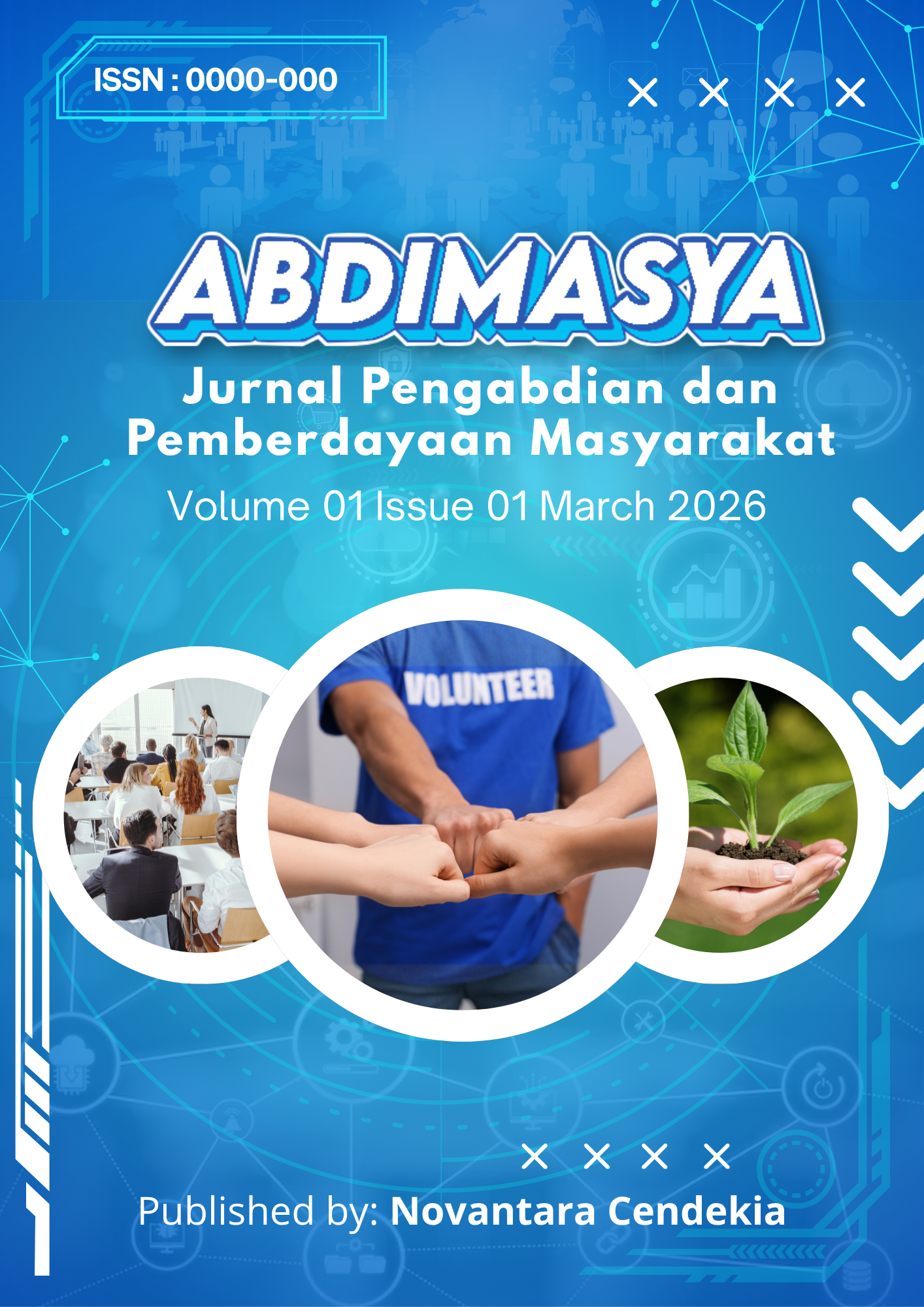
With great pleasure, we introduce the Inaugural Issue (Vol. 1, No. 1, March 2026) of Abdimasya: Jurnal Pengabdian dan Pemberdayaan Masyarakat. This issue marks the beginning of our mission to bridge academic research with community-based practices, ensuring that impactful service activities are documented and widely disseminated for the public benefit
Published:
2026-03-27
Articles
-
Empowering Mosque Youth: Digital Da'wah Content Creation for Islamic Propagation During Ramadan
Maskur Sekolah Tinggi Agama Islam Nurul Abror Al Robbaniyin Indonesia , Muhammad Rosuli Sekolah Tinggi Agama Islam Nurul Abror Al Robbaniyin IndonesiaRamadan represents a strategic period for strengthening Islamic propagation through community-based activities; however, many mosque youth organizations still face limitations in producing creative and high-quality digital religious content. At Nurul Ikhlas Mosque, youth members frequently consume social media but lack the technical competencies required to transform digital platforms into effective tools for Islamic da'wah. This community service program aimed to empower mosque youth by developing their skills in digital da'wah content creation during Ramadan. The program was implemented using an Asset-Based Community Development approach through participatory workshops and mentoring sessions involving members of the Nurul Ikhlas Mosque youth organization. Training activities focused on digital copywriting, graphic design, video editing, and social media management for Islamic communication. The results demonstrated significant improvements in participants’ digital literacy and creative competencies, as reflected in the production of more than thirty digital da'wah contents distributed through social media platforms. In addition, the program strengthened youth participation in mosque activities and encouraged collaborative learning within the community. The initiative concluded with the establishment of a youth-led digital media team to sustain content production beyond the program period. Overall, the program contributed to strengthening community empowerment by enabling mosque youth to become active agents of moderate Islamic propagation in the digital era
Pages: 1-12Views: - Downloads: -Enhancing Financial Accountability: Transparent Mosque Management for Zakat and Alms Optimization
Krisna Wichaksono Sekolah Tinggi Agama Islam Nurul Abror Al Robbaniyin Indonesia , Fathor Rohman Sekolah Tinggi Agama Islam Nurul Abror Al Robbaniyin Indonesia , Nur Moh Imron Arifandi Sekolah Tinggi Agama Islam Nurul Abror Al Robbaniyin IndonesiaMosques play a strategic role in managing Islamic philanthropic funds such as Zakat, Infaq, and Alms to support community welfare. However, many community mosques still rely on traditional financial management practices that lack standardized reporting systems and transparency, potentially limiting the optimization of charitable resources and reducing public trust. This community service program aimed to enhance financial accountability and strengthen transparent management practices for Zakat and Alms at Nurul Hikmah Mosque in Pemuteran Village, Buleleng, Bali. The program employed a participatory implementation approach through financial literacy workshops, technical mentoring, and collaborative capacity-building activities involving mosque administrators (Takmir) and youth members (Remas). The intervention focused on introducing systematic financial recording procedures, transparent reporting mechanisms, and simple digital financial management tools suitable for community-based institutions. The results demonstrated significant improvements in participants’ knowledge of financial governance, technical accounting skills, and the ability to produce transparent financial reports for mosque activities. The adoption of a standardized reporting system also strengthened institutional accountability and increased community confidence in the management of Zakat and Alms funds. Overall, the program contributed to community empowerment by reinforcing responsible financial governance and supporting sustainable socio-economic development within a minority Muslim community context.
Pages: 13-24Views: - Downloads: -Navigating AI Ethics: Integrating Character Education and Academic Integrity in Student Learning
Indi Aunullah Sekolah Tinggi Agama Islam Nurul Abror Al Robbaniyin Indonesia , M. Sholahuddin Al Ayyubi Sekolah Tinggi Agama Islam Nurul Abror Al Robbaniyin IndonesiaThe rapid development of generative artificial intelligence (AI) in education has created new challenges related to academic integrity, declining reading interest, and excessive dependence on instant digital solutions among students. These issues were observed among students of SMK Nurul Abror Al Robbaniyin, where the ease of accessing AI-generated content often reduced students’ motivation to engage with academic literature and critical learning processes. This community service program aimed to strengthen students’ ethical awareness in utilizing AI technologies by integrating character education with digital literacy. The program was implemented using a service learning approach combined with participatory action research through a series of workshops, ethical discussions, and guided learning activities focusing on responsible AI usage and critical reading practices. The results of the program indicated a significant improvement in students’ understanding of academic integrity principles, increased awareness of ethical AI usage, and renewed engagement with library resources as part of hybrid research practices. Students demonstrated better ability to differentiate between ethical AI assistance and academic dishonesty while maintaining responsible learning behavior. This initiative contributes to strengthening ethical digital literacy and provides a practical model for integrating character education with AI literacy to support sustainable learning and responsible technology use in vocational education environments
Pages: 25-36Views: - Downloads: -Interactive Learning Innovation: Utilizing Canva and Quizizz to Boost Motivation and Digital Literacy
Halimatus Sa'diyah Sekolah Tinggi Agama Islam Nurul Abror Al Robbaniyin Indonesia , Ahmad Silmul Fuady Sekolah Tinggi Agama Islam Nurul Abror Al Robbaniyin IndonesiaThe rapid development of digital technology in education has created new challenges for schools, particularly in fostering student motivation and digital literacy. At SMK Nurul Abror Al Robbaniyin, learning activities were still dominated by conventional lecture-based methods, resulting in limited student engagement and low utilization of educational technology for creative learning. This community service program aimed to enhance students’ learning motivation and digital literacy through the integration of interactive digital tools, specifically Canva and Quizizz. The program was implemented using a technology-integrated pedagogical approach that combined experiential learning with hands-on workshops. The activities included training sessions on designing educational infographics using Canva and participating in gamified learning assessments through Quizizz. The results demonstrated significant improvements in students’ participation, motivation, and ability to produce creative digital learning materials. Students showed increased enthusiasm during interactive quizzes and successfully created visually structured educational content. These outcomes indicate that integrating visual design platforms and gamified assessment tools can transform passive learning environments into more engaging and participatory experiences. The program concludes that the adoption of interactive educational technology can strengthen digital competencies and support sustainable learning innovation in vocational education settings. This initiative contributes to community empowerment by equipping students with practical digital skills necessary for lifelong learning and future professional readiness.
Pages: 37-47Views: - Downloads: -Accelerating Halal Certification and Digital Branding: Empowering MSMEs through Legal Compliance
Mabruroh Sekolah Tinggi Agama Islam Nurul Abror Al Robbaniyin Indonesia , Sofiatul Wahidah Sekolah Tinggi Agama Islam Nurul Abror Al Robbaniyin Indonesia , Novi Fitriana Sekolah Tinggi Agama Islam Nurul Abror Al Robbaniyin IndonesiaThe rapid expansion of the halal industry has created significant opportunities for micro, small, and medium enterprises (MSMEs) to enhance their competitiveness through halal certification and professional branding. However, many MSME owners in Pemuteran Village, Buleleng, operate within informal economic structures with limited awareness of halal certification procedures and digital marketing strategies. This community service program aimed to empower MSMEs by accelerating the acquisition of Business Identification Numbers (NIB), facilitating halal certification through the Self-Declare scheme, and strengthening digital branding capacities. The program was implemented through a participatory empowerment approach that combined legal mentoring with practical training workshops. Activities included assistance in NIB registration via the Online Single Submission system, mentoring in halal certification submission through the SIHALAL platform, and digital branding clinics focused on logo design and social media marketing. The results demonstrated significant improvements in MSME legal literacy, successful submission of halal certification applications, and the creation of professional digital brand identities for participating businesses. These outcomes strengthened consumer trust, improved product competitiveness, and expanded market opportunities in digital marketplaces. The program concludes that integrating legal compliance with digital branding strategies can significantly enhance MSME empowerment and contribute to sustainable local economic development within the halal industry ecosystem.
Pages: 48-58Views: - Downloads: -Additional Menu
Make a Submission
Download Template

IN COLABORATION

CHAT US

E-ISSN
ABDIMASYA: Jurnal Pengabdian dan Pemberdayaan Masyarakat menerbitkan artikel ilmiah hasil diseminasi program pengabdian, pendampingan, dan penerapan inovasi/teknologi terapan guna mendukung transformasi sosial masyarakat.
Penerbit: CV. Novantara Cendekia, Indonesia
|
ISSN: e-ISSN 0000-0000 / p-ISSN 0000-0000
|
© 2026 Novantara Cendekia. Dikelola dengan OJS.
Email: admin@novantara.org • WA: +62 87722522277
Sanguline Theme by
Sangu Ilmu